Showing posts with label leftover yarn. Show all posts

Thursday, 14 February 2019

DIY Upcycled Sewing Thread Reels Wreath

Today I'm sharing a tutorial for making a fun crafty wreath from your old empty reels of sewing thread!

Colourful yarn wreath decorated with upcycled sewing reels
 Yarn-wrapped wreath decorated with upcycled sewing reels
Yarn-wrapped wreath decorated with colourful upcycled sewing thread reels

ADVERTISEMENT: This tutorial is sponsored by Bostik, and is part of a series of crafty projects I'm sharing to promote their range of adhesives. Click here to see all the posts in the series!

I'm never sure quite what to do with my leftover thread spools - they don't really have an obvious purpose but I still can't quite bring myself to throw them away. "I'm sure these will be useful for something" I think to myself, sticking them in a box of craft supplies... and then never actually doing anything with them. I bet you guys have a bunch of stuff you keep like this, too, right?? You just never know when stuff might come in useful for crafting!

empty sewing thread reels

So, when the team at Bostik asked me to come up with a project to try out their new Fix & Flash glue I thought this would be the perfect opportunity to get out my stash of empty spools and actually make something with them.

 Bostik Fix & Flash glue

Making this wreath I also got to use up a bunch of scrappy bits of leftover yarn I'd been saving for ages AND I saved a bit of cash by making my own wreath base from a cardboard box instead of buying one. Essentially I felt like a crafty upcycling genius working on this project.

Colourful yarn-wrapped wreath decorated with upcycled sewing reels

Tip: if you don't have any empty thread reels but like idea of making one of these wreaths for your craft room, you could also make this project using a box of cheap sewing threads or those thread colours in your stash that you somehow have loads of but never actually sew with.

You will need:

- Bostik Fix & Flash (which I'm reliably informed is available at Hobbycraft) or other suitable strong glue
- Empty sewing thread reels
- A wreath base or a large piece of sturdy card (e.g. from a big cardboard box)
- Yarn for wrapping the wreath
- Leftover bits of yarn in assorted colours (or bits of felt, fabric or coloured paper)
- A sewing needle with a large eye
- Sewing scissors

If you're making your wreath base from card instead of using a shop-bought one you'll also need sturdy craft scissors, a pencil, and things to help you draw the wreath shape (I used a compass, a ruler and a large dinner plate). You will also need some PVA or other craft glue if you're decorating your reels with felt, paper or fabric.

To make the wreath:

1. If you're making your own wreath base (instead of just buying one from a shop), you'll need to cut a large ring shape out of sturdy cardboard.

I used a large dinner plate (approx 26 cm wide) for the outer circle, drawing around it with a sharp pencil. I then used a ruler to find the rough centre point of the large circle, and used a compass to draw the inner circle (approx 12.5 cm wide) around that central point.

It doesn't matter exactly what size wreath base you make or use, just ensure you've got enough space to add all your sewing thread reels!

 use a large plate to draw the wreath shape
cut out the wreath shape from strong card

2. Use some brightly coloured yarn to wrap your wreath base. Knot the end of the yarn around the ring shape, tying it securely so the knot will be at the back of your finished wreath. Then gradually wrap the whole of the wreath with yarn until the shape is evenly covered and there are no gaps for the base to peek through. When you're happy with how it looks, cut the yarn end and knot it securely at the back of the wreath.

This step is quite time consuming, but it's a lovely relaxing task to do on the sofa in the evening while watching a bit of telly!

wrap the wreath base with yarn

3. Now it's time to decorate your empty thread reels. Leftover bits of yarn are perfect for this, but you could also use pieces of felt or even colourful paper or fabric to wrap around the empty spools - just cut the colourful scraps to size and glue them in place with the appropriate craft glue.

When choosing colours you could stick to a strict colour palette for your reels, create a riot of different colours, or even create a rainbow effect across the wreath. I had lots of bits of leftover yarn in pink and other warm tones, so I chose a selection of those.

Tip: if you want a rainbow or another sweep of colour across the wreath, plan ahead and work out how you're going to position the reels before you start adding colour to them so you know which reels to add which colours to. I'd recommend using a large piece of paper and a pencil to mark out the positions of each reel, which you can then refer to as a guide when attaching them to the wreath. 

Wrap each empty reel with some leftover yarn, knotting the ends securely and trimming them neatly. Make sure both knots are on the same side of the reel, so you can hide them when you stick the reels in position! I hid the first end of my yarn under the rest as I wrapped it around the reel and used a sewing needle to help me loop the second end into the rest of the yarn to secure it.

wrap the empty reels with leftover bits of yarn
old sewing thread reels wrapped with colourful yarn

4. Once you've decorated all your spools, it's time to get out the glue and add them to your yarn-wrapped wreath base. I'd usually use a glue gun when sticking stuff onto wreaths but I often find glue guns quite awkward to work with and occasionally a bit messy (all those trailing strands of glue! and great squidges of glue that squeeze out from behind the thing you've just stuck in place!)... so I was really interested to try Bostik's new Fix & Flash glue.

using Bostik Fix & Flash glue to make an upcycled wreath

It turns out that using this stuff is half like being in a sci-fi film set in the future, and half like pretending to be a wizard because the glue sets like magic with a beam of light!

First use the fine nozzle to apply the clear glue to the back of one of the sewing reels, where it'll touch the wreath base. I'd definitely recommend test glueing something to start with as I managed to splurge glue everywhere as it was much more liquidy than I'd been expecting. Carefully position the reel and press it in place for a few seconds to create the initial hold.

attaching the first thread reel to the wreath

Then use the UV bulb at the other end to shine a beam of light for fifteen seconds onto the edges of where you've glued. And that's it! The glue has set.

using the Fix & Flash UV light beam

Make sure you follow the safety instructions when using the Fix & Flash (both the glue and the UV light), and gradually add all the reels to your wreath base. I set a little timer on my phone for 17 seconds so I could just tap that and easily time the amount of light needed. 

decorating the wreath with the upcycled thread reels

I will confess that I managed to get a bit of glue on my fingers when working on this project (oops) because I am quite clumsy and really ought to always wear latex gloves when using strong glue (because of the aforementioned clumsiness) but otherwise I was really pleased with how easy this stuff was to use. I definitely felt like I had more control over it than using a glue gun, and you can use Fix & Flash to glue loads of different materials.

I would never have tried this without Bostik asking me to create this tutorial, but I'm glad I did as I think this will be a really useful addition to my craft supplies stash!

Once you've added all the reels to your wreath it should look something like this:

finished yarn-wrapped wreath decorated with upcycled sewing thread spools

Hang the wreath from a hook or nail using more of the same yarn you used to wrap the wreath base earlier.

DISCLOSURE: this post is sponsored by Bostik, who also provided the Fix & Flash I used to make the wreath. 

P.S. Fancy some more free crafty goodness? Subscribe to my newsletter for a monthly free pattern and visit my crafty tutorial archive for lots more free projects.

Make a colourful yarn wreath for your craft room

Friday, 20 April 2018

Knitting a Patchwork Blanket of Mini Squares with Leftover Yarn

I finished my mini patchwork squares blanket this week! Yay!

This project has been a work-in-progress for such a long time, I thought it might be nice to take a look back at how it's developed over the years. 


I started knitting mini squares in September 2011 (the arrival of autumn always makes me want to knit stuff - how about you?).


Each square was ten stitches across, knitted with moss stitch on size 10 (3.25 mm) needles.

I didn't have a plan for what I was going to use them for, I just wanted to make something out of the yarn (in a general spirit of "waste not want not") and thought knitting little squares was a good first step towards turning my leftover yarn into something useful. Every time I had a small ball of yarn left over from a knitting project I'd knit some more little squares, then pop them in a bag with all the others. By July 2012 I'd knitted about 150 squares and the bag continued to fill up.

In the summer of 2014 I decided to use the squares to make a blanket. It was originally going to be a small picnic blanket (inspired by having been to a picnic where everyone but me had lovely picnic blankets) but I soon decided it was going to be a curling-up-on-the-sofa blanket instead.

I decided to build up my blanket gradually, sewing the squares into blocks then sewing the blocks together to make up the blanket. Here are the first few blocks I stitched together:


It was quite exciting finally having a plan for the squares and making a start on sewing them all together.


As the months went on I continued to knit mini squares whenever I had any leftover yarn...

.

... sewing the squares into blocks...


 ... then adding them to the growing blanket.

It was really fun seeing the blanket develop organically as I just went with the flow and used whatever colours I had, adding to the blanket little by little.

By January 2015 I had 270 squares stitched together and the biggest section of the blanket looked like this:


Unsurprisingly, everyone always says this blanket reminds them of the video game Tetris!

I love these blocks of colour. They give the blanket a kind of controlled randomness, showcasing the colours and making the whole design look consistent instead of being just a jumble of individual squares (which I think would have driven me bananas). Really importantly for me, using the blocks meant I felt happy starting sewing the squares together way before I had enough squares for a whole blanket. 

There were, of course, a lot of ends to weave in and trim along the way!


I originally joined the blocks together in a few different sections, so I could spread the colours out more evenly across the blanket. I finally joined them into one big piece in December 2015, when I laid all the pieces out on the floor, worked out the final size I wanted the blanket to be (30 x 30 squares) and decided how the already-knitted pieces would best fit together within it.


Because I am a nerd who enjoys making charts, I decided to use a bit of squared paper and some felt tip pens to make a little chart to track my blanket's progress and get a better idea of how the "design" was developing.


I'm really glad I did this because it ended up inspiring the final design of my blanket!

Instead of spending many years slooooowly knitting another 400+ squares from leftover yarn, I decided to stick with a central sweep of colour and keep the rest of the blanket plain white. I loved how the colour popped against the white but I also loved the idea of actually getting this blanket finished before my 40s.

Of course, this meant I needed to knit a LOT of little white blanket squares. I started knitting them in the spring of 2016, but not yet joining them to the coloured squares in case I wanted to add extra squares to the central sweep.


Knitting the white squares was pretty repetitive (and not particularly photogenic) but it was a great relaxing task to do in front of the TV in the evenings.

By March 2017 I had a big bag of white squares and the main section of the blanket looked like this:


I abandoned the blanket for months at a time, working on the project in fits and starts. Sometimes the idea of it totally bored me and other times I worked on it obsessively. This is the kind of labour-intensive, repetitive project which could easily become infuriating if you worked on it when you weren't in the mood to. I'd added 514 squares to the blanket by the spring of 2017 and that's a lot of hours of knitting and sewing!


I began joining the white squares to the blanket later that year, sewing together the stash of squares I'd knitted so far then gradually adding new squares as I knitted them.

I had to do a bit of unpicking in November 2017, as this dark red block was really bugging me and I decided I could stand it no longer. It didn't fit nicely with the sweep of colour across the blanket and the squares didn't look remotely square, so I cut it out and replaced it with white. Unpicking all that red yarn took forever but it was totally worth it!


I slowly knitted more white squares over the winter, adding them to the blanket as I went along. Then with the end in sight (always an exciting time) I did a big push in March to get to the finish line. It started really looking and feeling like a proper blanket instead of just a big unwieldy yarn shape, and I couldn't wait to get it finished!

Here it is with 52 squares to go in late March.


After a flurry of knitting, I finished the blanket this weekend. The final job was, of course, to weave in a whole bunch of white yarn ends.


I knitted the first few squares in September 2011, and wove in the final yarn ends in April 2018... so it's taken me about six and a half years from start to finish. Is that a long time to be working on a blanket? I don't know. It feels wonderful to finally have it finished, anyway.

Six and a half years. 900 mini squares knitted and sewn together. 1,800 yarn ends woven in. I have no clue how many hours I've spent on this project, but it's a lot!

I'm going to lazily bask in that glorious "finished project" feeling for a bit, then take some nice photos of the finished blanket to share with you guys asap. If you fancy making your own mini squares blanket and have any questions about how I've made mine, do let me know in the comments. 

P.S. Subscribe to my newsletter for a monthly free pattern and visit my crafty tutorial archive for lots more project ideas.

Visit my shop to buy my printable PDF sewing patterns:


Monday, 15 January 2018

Tutorial: Use Leftover Yarn Ends to Make Colourful Stripey Cards!

If you knit or crochet, you probably end up with lots of scrappy bits of yarn left over at the end of each project. It feels kind of wrong just throwing them away (especially if they're lovely colours)... but what do you do with them?

Today I'm sharing one idea for using them up: making stripey notecards!

 Notecard decorated with yarn stripes

These cards are easy to make and I think they look rather fabulous. The yarn stripes are simple but textured, and you could have lots of fun choosing colour combinations for each card.

You will need:

- Blank card (I chose black, but any colour will do), cut and folded to the size you want (I made an A6 size card, folded from a piece of A5 card)
- Yarn, in assorted colours
- A ruler
- A pencil
- Sewing scissors
- A large, sharp sewing needle
- Optional: a pencil eraser

Handmade card decorated with lines of yarn

To make each card:

1. Select some yarn in a colour palette you like. Each piece should be at least 20cm long.

2. Open up your blank card, and use a ruler and pencil to draw two horizontal lines on the inside of what will become the front of your card. One line an inch (2.5cm) from the top of the card, and the second an inch (2.5cm) from the bottom.

3. Use the ruler to measure the central point of each line, marking it with a small pencil dash. Then mark seven dashes either side of these central points, each 5mm apart. You should now have 15 points marked along each line.

4. Use a large, sharp needle to poke a hole through the card at each one of the points you've marked. Place the card on a pile of scrap paper to protect your workspace as you poke the needle through!

If you want, you can now erase the pencil lines. 

5. Choose your first piece of yarn, and thread the large needle with it. Pass the yarn up through one of the holes at the bottom of the card and then down through the corresponding hole at the top of the card. Leave the yarn ends dangling (they should stay in place due to the small size of the holes), then repeat this step to add all the yarn stripes.

6. Knot the yarn ends together to secure the stripes, and carefully trim any excess yarn. You could add a piece of tape to cover the ends but I quite like how mine look!

Knots on the inside of the card to secure the yarn

And that's it! Your card should now look something like this:

Minimal modern card decorated with leftover yarn

Enjoyed this free tutorial? Buy me a "coffee" and help support my blog!

Buy Me a Coffee at ko-fi.com

Subscribe to my newsletter for a monthly free pattern and visit my crafty tutorial archive for lots more free projects.

Visit my shop to buy my printable PDF sewing patterns:

Wednesday, 25 October 2017

Gift Wrapping with Yarn & Embroidery Thread

Today's gift wrapping ideas are all about yarn and colourful threads.

Yarn.  

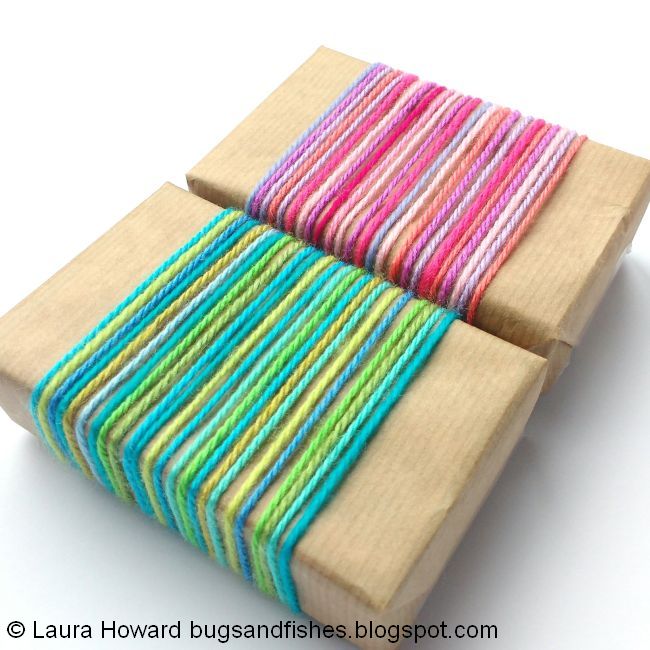
This is a really fun way to use up leftover yarn from your knitting and crochet projects! It works best for small parcels (so you can use up shorter scraps) but if you've got whole balls of yarn left over you can wrap larger gifts this way as well.


For this project I selected some colours from my stash that went together (fresh blues and greens, and bright pinks and purples), then tied lots of yarn pieces of around a couple of small parcels to form bands of colour.


Use one length of yarn to test out how long a piece you need to reach around the parcel and tie the yarn securely, then use this bit of yarn as a size guide when cutting the other pieces. Add the yarn pieces gradually, mixing the colours to create a pattern or a nice blend of shades.

Position the yarn so it's all in a neat block in the centre of the package then trim any excess yarn so the underneath of the parcel is nice and neat. You may also want to add a bit of sticky tape to the bottom of the parcel to hold the strands in place if you'll be transporting the parcel.

Woven Threads.

This idea is a lot more subtle than some of my gift wrapping suggestions, but I kinda love it anyway.


For this look, you'll need some embroidery thread (or yarn or narrow ribbons). I used two colours but you could use all one colour or combine lots of different shades (e.g. if you're using bits of yarn or thread left over from other projects).


Cut a length of thread and tie it horizontally across the parcel, with the knot hidden underneath. Trim any excess thread and secure the knot in place with a piece of sticky tape. Repeat to create several horizontal lines across the parcel. If you're using ribbon, secure each end of the ribbon with sticky tape instead of knotting it so the ribbon lies totally flat against the parcel.

Then repeat this process with the second colour, creating vertical lines. This time, weave the thread between the horizontal threads (over, under, over, under, and so on) before securing it. Ta-da! One woven parcel.

Enjoyed this gift wrapping idea? Buy me a "coffee" and help support my blog!

Buy Me a Coffee at ko-fi.com

Subscribe to my newsletter for a monthly free pattern and visit my crafty tutorial archive for lots more free projects.

Visit my shop to buy my printable PDF sewing patterns:

Wednesday, 21 September 2016

100 Gift Wrapping Ideas, Part One: From Pompoms to Hydrangeas to Old Photo Negatives!

I recently set myself a challenge, to share 100 crafty gift wrapping ideas over the coming weeks and months. And... I've just completed the first 10 ideas! Hurrah!

collage of gift wrapping ideas

I know I'm only a little way through this challenge, but I'm really enjoying it so far and I hope you guys are too.

I've started with a plain, brown paper parcel each time. I love the simplicity of brown paper (it's a great blank canvas!) but you could use any plain gift wrap you fancy.

1. Pompoms.

gifts decorated with pompoms

2. Beads.

parcel decorated with wooden beads and yarn

3. Lavender & Washi Tape.

gifts decorated with polkadot washi tape and lavender

4. Buttons.

parcels decorated with pastel buttons

5. Hydrangeas.

brown paper parcel with a hydrangea bloom as a gift topper
three gifts decorated with hydrangea blooms

6. Painted Leaves.

simple parcels decorated with painted leaves

7. Feathers. 

parcel decorated with colourful craft feathers

8. Woven Threads. 

parcel wrapped with a grid of woven threads

9. Yarn. 

gifts wrapped with bright and colourful yarn scraps

10. Photo Negatives. 

parcel decorated with old photo negatives


And now... my challenge continues! You can follow along on my Instagram, Twitter and Facebook. I'm sharing the gift wrapping ideas under the hashtag #100giftwrappingideas as I slowly work my way up to 100.

You'll also find lots of creative gift wrapping ideas in my archive of free crafty tutorials (scroll down to the bottom of the page, you'll find card and gift wrap ideas below the Christmas tutorials).

P.S. Subscribe to my newsletter for a monthly free pattern and visit my crafty tutorial archive for lots more free projects.

Visit my shop to buy my printable PDF sewing patterns:


100 Gift Wrapping Ideas: Part One